
Motorcycle Oil Myths: Mixing Oils, Car Oil, Synthetics, and Additives
Five common motorcycle oil myths explained with practical, manufacturer-first guidance on mixing oils, JASO ratings, synthetic labels, and additives.
Fact-checked by Vojo Editorial Team
Reviewed against Honda, Suzuki, JASO, and API documentation.
Last updated August 27, 2026
Motorcycle oil advice often arrives as a confident one-line rule: never mix brands, always buy motorcycle-specific oil, use only one premium brand, choose anything labeled fully synthetic, or add a treatment for extra protection. Each rule contains a fragment of a real concern, but none is a safe substitute for the specification printed in your motorcycle's owner's manual.
The manual wins because motorcycles do not all ask the oil to do the same job. In many bikes, one oil lubricates the engine, transmission, and wet clutch. Other motorcycles separate those systems. Required viscosity, friction performance, service interval, and approved oil category can therefore differ even between models from the same manufacturer.
This guide separates five common motorcycle oil myths from practical, manufacturer-first decisions. It is educational guidance, not a replacement for the manual or a qualified mechanic who can assess a specific motorcycle.
Read the label before debating the brand
Use the exact requirements in your owner's manual. These are the main markings you are likely to encounter:
| Marking | What it describes | What the rider should check |
|---|---|---|
| SAE 10W-40, 5W-40, etc. | The oil's viscosity grade at low and operating temperatures | Use a grade allowed by the manual for the temperatures in which you ride |
| API service category | A performance category for engine oil | Meet or exceed the category stated in the manual, while respecting any exclusions |
| JASO MA / MA1 / MA2 | Motorcycle oil friction performance for applications such as wet clutches | Use the exact JASO classification required by the manufacturer |
| JASO MB | A lower-friction JASO category | Do not substitute it in a wet-clutch motorcycle that requires MA or MA2 |
| Energy Conserving / Resource Conserving | Friction-reducing designation found on some automotive oils | Avoid it when the motorcycle manual excludes it |
For example, Honda manuals for several models specify an SAE grade, an API category, JASO MA, and an exclusion for oils marked Energy Conserving or Resource Conserving. Suzuki likewise explains that JASO MA and MA2 address motorcycle clutch-friction requirements. The correct answer is therefore a complete set of specifications—not a logo or a single viscosity number.
Myth 1: Motorcycle oils must never be mixed
What the evidence says
Commercial engine oils are designed to operate as complete formulations, but that does not make every mixture equivalent to the oil the manufacturer specified. Different products can use different base oils, viscosity modifiers, detergents, dispersants, and friction modifiers. Mixing may change the final viscosity balance or clutch-friction behavior in a way the rider cannot verify from the labels.
Manufacturer guidance can also be explicit. The 2015 Honda CBR600RR owner's manual tells owners not to mix different brands and grades because lubrication and clutch operation may be affected.
That does not mean a small emergency top-up inevitably destroys an engine. It means that “chemically mixable” and “approved for continued use in this motorcycle” are not the same claim.
What riders should do
- Use the same product for routine top-ups whenever possible.
- Do not deliberately blend oils to create a custom viscosity.
- If the level is dangerously low and the correct oil is unavailable, prioritize an oil that matches the manual's viscosity and performance specifications as closely as possible.
- Add only enough to restore a safe level; overfilling creates another problem.
- Replace the mixed fill with the correct oil and filter as soon as practical.
- Investigate why the level dropped instead of treating repeated top-ups as normal.
Myth 2: Car oil is always wrong for motorcycles
What the evidence says
The word “car” on a discussion forum and the word “motorcycle” on a bottle do not determine compatibility by themselves. The mechanical layout and the required specifications do.
Many motorcycles use a wet clutch and a shared engine-and-transmission sump. The JASO T 903 standard classifies four-stroke motorcycle oils partly by clutch-friction performance. An automotive oil designed to reduce friction for fuel economy may not provide the behavior required by that clutch system. The gearbox can also subject oil to different shear loads than it sees in a typical passenger-car engine.
Some motorcycles, however, use separate lubrication systems or permit oils that are not marketed exclusively for motorcycles. This is why a universal ban is just as unreliable as universal permission.
What riders should do
- Check whether the engine oil also serves the gearbox and wet clutch.
- Match every specification in the manual, including SAE, API, and JASO.
- Respect exclusions for Energy Conserving or Resource Conserving products.
- If the manual requires JASO MA or MA2, choose an oil that clearly carries that classification.
- Do not assume an automotive oil is suitable merely because its SAE viscosity matches.
Myth 3: One oil brand is always the best
What the evidence says
Brand reputation can help with product availability, quality control, and technical support, but no logo is the correct answer for every engine, climate, riding pattern, and service interval. A premium product with the wrong viscosity or clutch classification is still the wrong product for that motorcycle.
Garage experiments based on color, freezer flow, smell, or an improvised wear test cannot reproduce a recognized engine-oil test sequence. They may look persuasive on video while measuring little about long-term deposit control, oxidation, shear stability, clutch behavior, or compatibility with seals.
Authenticity matters as well. Buy from a reputable retailer, inspect the seal and batch markings, and keep the receipt. Counterfeit risk is a reason to verify the supply chain, not a reason to treat one brand as universally superior.
What riders should do
- Start with the specification, not the brand.
- Compare products only after they meet the complete manual requirement.
- Prefer an established supply channel and intact packaging.
- Keep the oil and filter receipt with the service record.
- Judge performance over the manufacturer's service interval, not by an unstandardized bench trick.
Myth 4: “Fully synthetic” tells you everything about quality
What the evidence says
“Synthetic” is a broad product description, not a complete technical specification. The API 1509 system describes multiple base-stock groups, while finished oils combine base stocks with additive packages designed to meet performance targets.
Base-oil technology can influence cold-flow behavior, volatility, oxidation resistance, and price. Yet the finished oil's viscosity, approvals, formulation, and fitness for the motorcycle matter more than a single marketing phrase. A correctly specified mineral or synthetic-blend oil changed on schedule can be a better decision than an expensive synthetic product that lacks the required clutch classification.
What riders should do
- Treat “fully synthetic” as one product characteristic, not an approval.
- Verify the SAE, API, and JASO markings separately.
- Follow the manufacturer's change interval unless the manufacturer provides an alternative interval.
- Do not extend an oil-change interval solely because the bottle says synthetic.
- Select for the motorcycle and operating conditions rather than the highest price.
Myth 5: Aftermarket oil additives always extend engine life
What the evidence says
Engine oil already contains a balanced additive package. Detergents, dispersants, anti-wear agents, corrosion inhibitors, antioxidants, and viscosity modifiers are formulated to work together. Pouring another treatment into the sump changes that balance without demonstrating that the resulting mixture still meets the original performance claims.
This is especially relevant where engine oil also serves a wet clutch. Added friction modifiers may change clutch behavior. The 2012 Honda CB1000R owner's manual says the motorcycle needs no oil additives and warns against oils containing graphite or molybdenum additives because clutch operation may be affected.
An additive can also mask a symptom without repairing its cause. Noise, oil consumption, low pressure, or metal debris calls for diagnosis—not a thicker mystery mixture.
What riders should do
- Do not add an aftermarket treatment unless the motorcycle manufacturer explicitly approves it.
- Use an oil that already meets the required specification.
- Diagnose leaks, abnormal noise, clutch slip, and oil consumption.
- If a workshop recommends an additive, ask for the relevant manufacturer instruction and the exact product approval.
Five myths at a glance
| Myth | Better conclusion | Safest action |
|---|---|---|
| Oils are either perfectly mixable or must never touch | Emergency compatibility is not the same as approved long-term performance | Avoid routine mixing; match the manual in an emergency and correct the fill soon |
| All car oil is unsuitable | Suitability depends on the motorcycle's lubrication layout and required specifications | Confirm SAE, API, JASO, and friction-related exclusions |
| One brand is always best | Correct specification and authentic supply matter more than brand loyalty | Choose a compliant product from a reputable seller |
| Fully synthetic always means superior | The label does not replace viscosity and performance approvals | Evaluate the complete specification and follow the service interval |
| Extra additives provide extra protection | An unapproved additive can disturb a balanced formulation | Use no additive unless the manufacturer permits it |
Motorcycle oil buying checklist
- Find the oil section in the owner's or service manual.
- Confirm the allowed SAE viscosity for the expected ambient temperature.
- Confirm the minimum API service category.
- Confirm whether the motorcycle requires JASO MA, MA1, or MA2.
- Check for warnings about Energy Conserving or Resource Conserving oil.
- Confirm the required quantity, including the difference between a drain and a filter change.
- Buy the correct filter and sealing washer where applicable.
- Purchase from a traceable, reputable seller.
- Plan the change interval by both mileage and time.
Emergency top-up checklist
- Stop safely and check the level using the procedure in the manual.
- Check for an active leak before restarting the engine.
- Use the same oil already in the motorcycle if it is available.
- Otherwise match the required SAE, API, and JASO specifications as closely as possible.
- Add small amounts and recheck; do not overfill.
- Ride gently and monitor the oil-pressure warning and clutch behavior.
- Restore the correct oil and investigate the oil loss promptly.
Keep the service evidence in Vojo
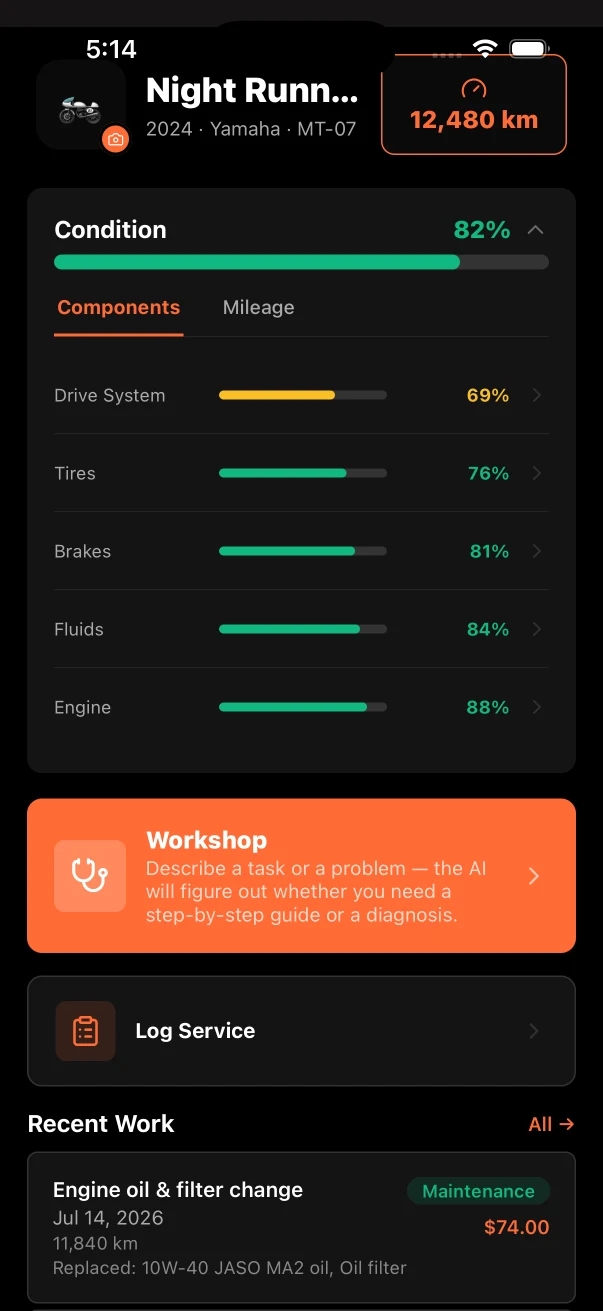
After an oil and filter change, record the date, mileage, oil specification, quantity, filter, and receipt. In Vojo Garage, the motorcycle profile keeps its mileage and component condition in one place. The service history makes it easier to prove what was used and calculate the next interval instead of relying on memory.
Oil is only one part of the maintenance schedule. Use the motorcycle maintenance by mileage guide to organize recurring work, run through the pre-season checklist after storage, and review common motorcycle failures when a symptom needs context. For model-specific questions, Vojo AI Workshop can help you organize the next diagnostic steps, but its output should still be checked against the manual.
10W-40 vs 5W-40: the short answer
The two grades share an SAE 40 high-temperature grade, while 5W is tested for lower-temperature cranking and pumping performance than 10W. That does not make 5W-40 an automatic upgrade. Use 5W-40 in place of 10W-40 only when the manual permits it for the expected temperature range and the oil also carries every required API and JASO classification.
Official sources and further reading
- 2015 CBR600RR Owner's Manual — Honda
- 2012 CB1000R Owner's Manual — Honda
- ECSTAR oil standards — Suzuki
- JASO T 903:2023 Implementation Manual
- API 1509 Engine Oil Licensing and Certification System
Important: This article provides general educational information. Your motorcycle's current owner's or service manual takes precedence. If the specification is unclear, consult the manufacturer or a qualified motorcycle technician before adding or changing oil.
Inside Vojo
See how Vojo turns maintenance into a useful record

Quick answers
Frequently asked questions
Can you mix motorcycle oil brands?
Avoid making it a routine practice. Some manufacturer manuals explicitly warn against mixing brands or grades because the combination can affect lubrication or clutch operation. If an emergency top-up is unavoidable, use the closest oil that matches the required viscosity and specifications, then restore the correct oil as soon as practical.
Can you use car oil in a motorcycle?
Only when the motorcycle's manual permits it and the oil meets every required specification. Many motorcycles share engine oil with a wet clutch and gearbox, so low-friction automotive oils may be unsuitable. Look for the required JASO classification and any warning against Energy or Resource Conserving oil.
What is the difference between JASO MA and MA2?
Both classifications are intended for four-stroke motorcycles where clutch friction matters. MA2 defines a higher friction range within the MA category. Use the exact classification required by the motorcycle manufacturer rather than assuming MA2 is automatically better for every bike.
Is fully synthetic oil always better?
Not automatically. Base-oil technology can improve properties such as low-temperature flow and oxidation resistance, but suitability still depends on the complete formulation, required approvals, viscosity, operating conditions, and change interval.
Should you add aftermarket oil additives?
Not unless the motorcycle manufacturer explicitly approves them. Engine oil is already a balanced formulation, and additional additives can interfere with clutch friction or the oil's existing additive package. Some Honda manuals specifically state that additives are unnecessary.
Can you replace 10W-40 with 5W-40?
Only if the owner's manual allows both grades for the expected temperature range and the replacement meets the same required API and JASO specifications. Sharing the same hot-viscosity number does not by itself make two oils interchangeable for every motorcycle.